AI Won't Kill Your Company
Failing to Redesign Jobs Will
AI Strategy requires
People Strategy

MIT Research : 95% Failure Rate for Enterprise AI Adoption. The reason : Obsolete Jobs + Latest AI = Zero ROI
JobADDIE is workforce transformation at AI speed, turning months of planning work into a single day. Every role, every level, across your entire organisation
Big Transformations happen in Small Loops

START : How are jobs changing in your industry?
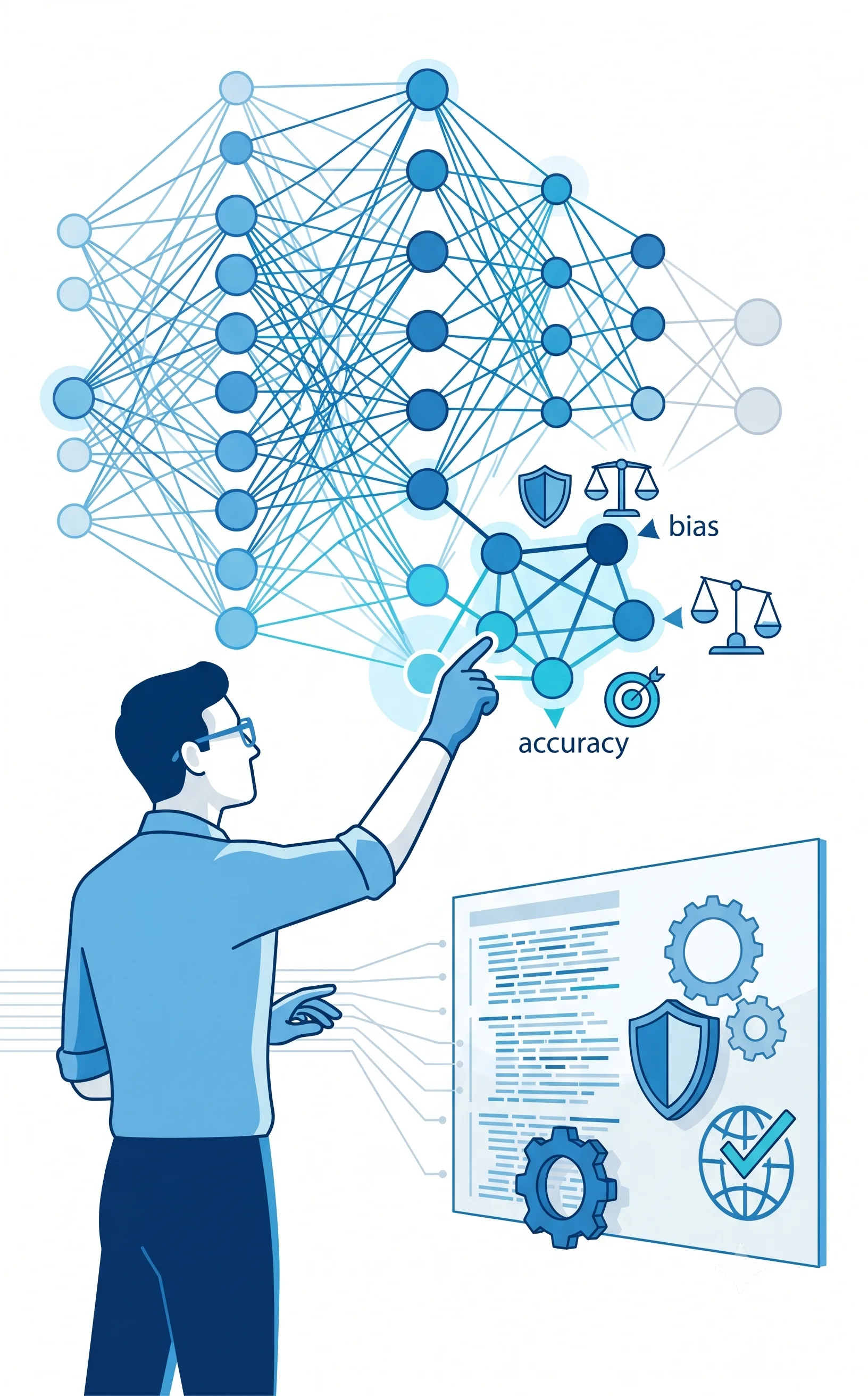
Audit & Assurance
External Auditor
Traditional random sampling is obsolete; auditors must now urgently acquire the technical skills to evaluate the integrity, bias, and accuracy of clients' proprietary AI algorithms and automated financial decision-making engines.




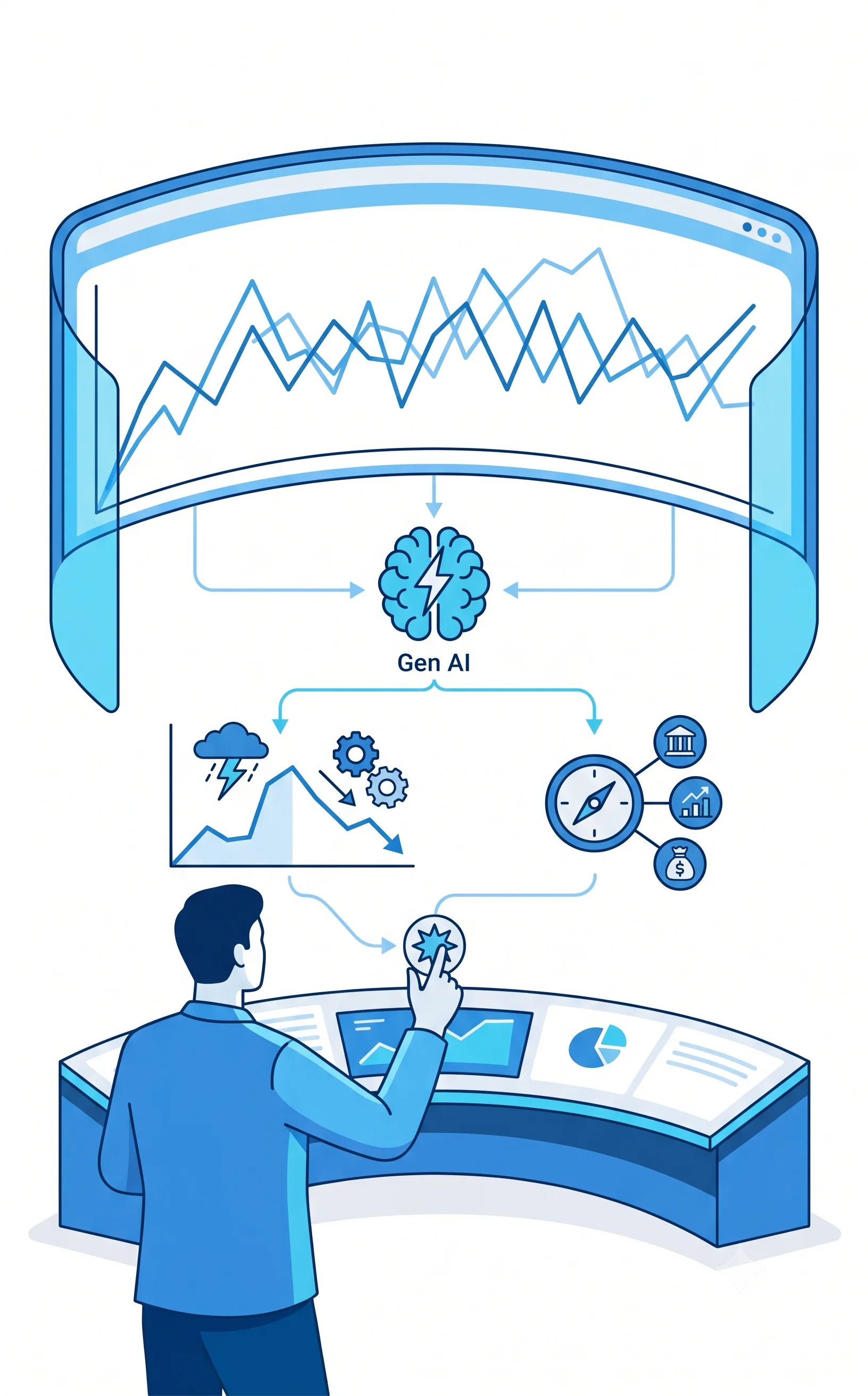
ANALYSE : Decide on a Goal
DESIGN : Plan what's needed to reach your goal
Business objectives are the main goals and operational needs of an organization. Identifying these goals ensures that job roles, tasks, and training programs directly fix performance gaps and achieve real business results.
A Job Role defines a person's occupation, outlining their career path, main responsibilities, and the key tasks needed to meet performance expectations.
A task is a specific piece of work with clear steps that forms the foundation of workplace performance. Analyzing tasks helps determine the best way and sequence to perform them, ensuring consistency across the organization.
Unique Skills are standardized, distinct capabilities that apply across different industries. They ensure the workforce remains adaptable and ready for future industry changes.
Skills are the specific technical or general abilities required to perform various job tasks effectively.
Contextualization details the specific company rules, industry standards, and legal requirements needed to make training relevant to the actual work environment.
Ability statements describe the specific, observable actions and behaviors a person must demonstrate to show they are capable.
Knowledge statements outline the factual information and understanding a person needs to perform their tasks effectively.
DEVELOP : Prepare easy-to-use materials for a smooth journey
The overarching, structured plan for an entire training program (Macro level). It outlines the broad goals and how the content is packaged and sequenced.
Individual courses or micro-level instructional blocks that come together to make up the overall curriculum. Modules can be categorized as Core (mandatory) or Elective (optional).
Smaller, sequenced topics or sections within a module, packaged logically to build knowledge step-by-step.
A detailed guide for the trainer, explaining the step-by-step activities, timing, and flow needed to deliver the learning unit effectively.
The physical or digital materials used by trainers and learners, such as the Facilitator's Guide, Learner's Guide, presentation slides, and handouts.
The specific teaching approaches—such as group discussions, role-plays, games, or case studies—used to engage learners.
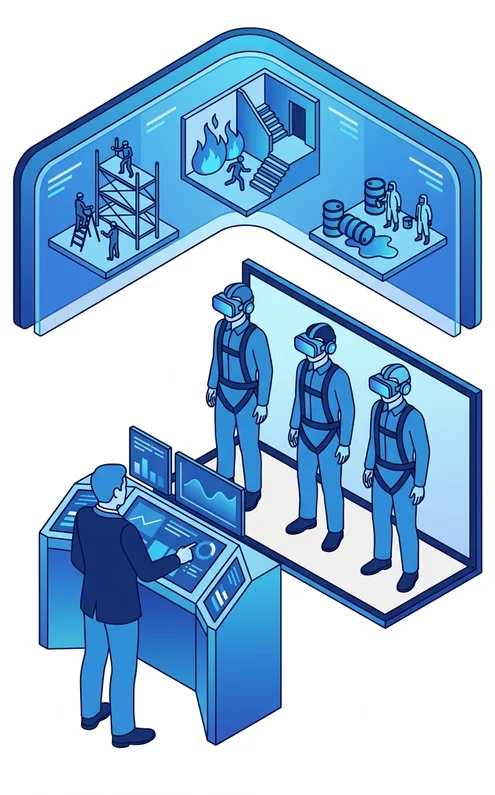
IMPLEMENT : Help your team learn and grow.
Workforce Transformation : Consistently Scalable, Economically Viable

- Complex problem solving
- Safe practice of new skills
- Social meaning-making
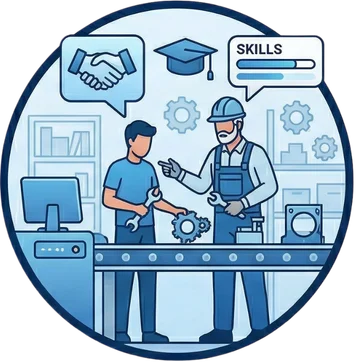
- On-the-job coaching
- Shadowing
- Practical skills in a real environment

- Foundational knowledge acquisition
- Bite-sized microlearning
- Accommodating busy schedules
The complete setup, rules, and resources a company uses to measure employee skills and performance.
The detailed blueprint outlining exactly how a specific module's test will be run and graded.
Identifies why the assessment is happening and who is taking it, factoring in learners' backgrounds and special needs.
The logistical details of the test, covering the location, time limit, setup, and the exact criteria needed to pass.
A table mapping the required job skills directly to the exact evidence needed and the methods used to test them.
The official forms where the assessor logs the learner's performance, final outcome, and feedback.
The actual materials and documents used to conduct the assessment.
EVALUATE : No guesswork. Success can be measured
The final stage to measure the quality, effectiveness, and business impact.
A clear plan defining what success looks like and how to measure it.
Specific targets and metrics, like increased sales or fewer errors, to judge if the training succeeded.
Data collected before training starts to serve as a starting point for proving improvement.
Updating and refining the training based on evaluation feedback.
Trainers analyzing their own performance to teach and design better in the future.
A standard model used to evaluate a training program's success after it has been delivered.
Measuring learner satisfaction and engagement immediately after the training ends.
Measuring the actual knowledge and skills learners acquired during the training.
Measuring how well learners apply their new skills on the job over time.
Measuring the business impact, like higher sales or productivity, tied to the original business goals.
Comparing the financial benefits gained from the training against the costs to develop and run it.
Congratulations 🎉🎉🎉!! Please choose your !
Chatbots vs AI Agents
ChatGPT needs
Hundreds of Prompts
With a chatbot like ChatGPT, you write every prompt/instruction,
fix every mistake, and start over when it loses track.
JobADDIE needs
One Goal
With JobADDIE, you set the goal
it works out how to get there

- You write every question yourself
- Misses whatever you forget to ask
- You have to drive the whole conversation

- Acts as your expert consultant
- Asks the right questions — you don't have to
- Nothing gets missed — ever
- Generic output — no idea who you are
- You explain your business every single session
- Forgets everything when the tab closes
- Type your company name — it does the research
- Industry and trends auto-researched
- Your context locked in permanently

- Only knows jobs that already exist
- Can't identify the skills your team needs next
- You end up training for a world that's disappearing
- Future skills identified automatically
- Mapped directly to your actual workforce
- Your team ready for what's coming — not what's gone
- Writes vague, unmeasurable goals
- Generic — doesn't match your actual workplace
- People finish the training. Nothing actually changes.
- Specific, measurable — built around your reality
- Tied to real tools and real behaviours
- Designed to change what people actually do
- Dumps everything at once
- No order, no logic — people get lost
- Learners switch off before the key points
- Breaks content into manageable pieces
- Builds knowledge in the right order
- Complete training plan — ready to hand off
- Defaults to read-then-quiz — every time
- Treats people as passive listeners
- Boring — kills respect for your training
- Hands-on activities built automatically
- Real scenarios from your employees' daily work
- People think and practise — not sit and memorise
- Forgets your briefing halfway through
- Slides back to generic, useless responses
- You re-explain everything from scratch each session
- Your goals locked in from day one
- Never drifts — always aligned to what you need
- Consistent from the first session to the last
- Loses track of the original goal
- You check every module manually for consistency
- Training falls apart — people fail on the job
- Every goal, lesson, and assessment stays in sync
- Aligned automatically — start to finish
- People perform correctly when it matters
- Generates text — no proof, no numbers
- Can't answer: "Did this training actually work?"
- Your training budget? Impossible to justify
- Business outcomes defined from day one
- Proves cost savings and productivity gains
- Every programme ships with a CFO-ready business case
- Writes basic true/false questions
- People pass without learning a thing
- Zero proof they can actually do the job
- Job-readiness checklists and real performance tasks
- Proves people can actually do the work
- Every assessment tied to real job outcomes
What your team can do with JobADDIE



AI Strategy requires People Strategy. Build it today.
Drop your email — we'll show you exactly what JobADDIE produces for your sector.